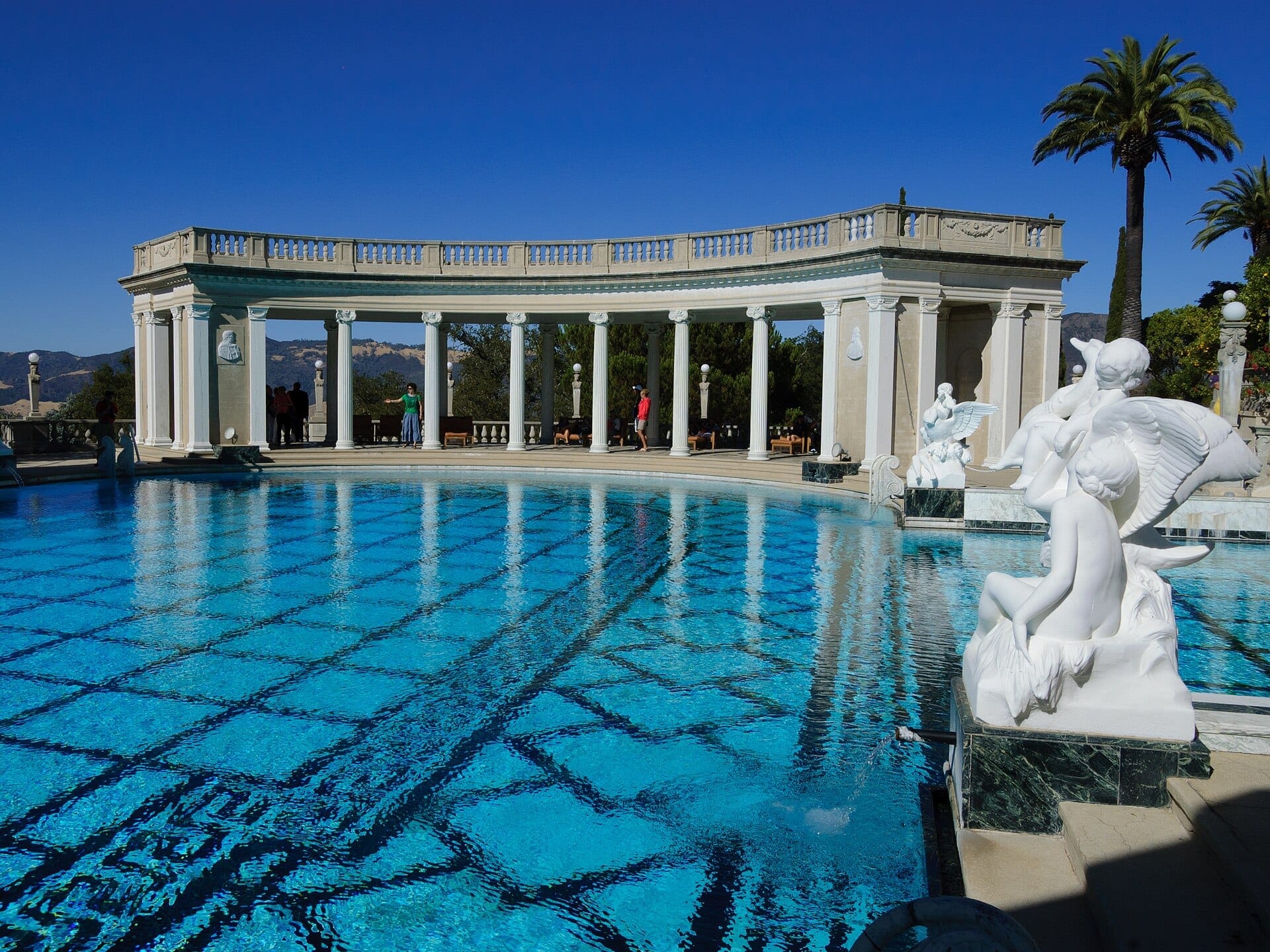
 Photo: "Hearst Castle Neptune Pool" by King of Hearts (Wikimedia Commons user), CC BY-SA 3.0, via Wikimedia Commons
 Hearst Castle
750 Hearst Castle Road, San Simeon, CA 93452
The Story
The Enchanted Hill
Once the most coveted ticket in Tinseltown, an invitation to William Randolph Hearst's grand Spanish finca in San Simeon was a clear sign that you had made it in 1930s Hollywood. Hearst formally named his kingdom "La Cuesta Encantada" — The Enchanted Hill — and the name was no exaggeration: set on a craggy hilltop with 360-degree panoramic views of the Pacific, the estate drew Hollywood's biggest stars for three decades. Hearst's father George was a silver-mine owner who struck it rich in the early 1850s and bought large chunks of California with the windfall, including 40,000 acres near San Simeon. It was at the family's little hacienda in the hills that the young William Randolph spent carefree summers in the wilderness — and where, years later, he chose to build his dream house.
"Hearst collected people like he did fine art, carefully curating his guest list with the help of his lover and hostess, Marion Davies.
Julia Morgan, the woman who built the castle
In 1919, Hearst hired San Francisco architect Julia Morgan — the first woman granted an architect's licence in California — to build his home. Their collaboration lasted nearly three decades, from 1919 to 1947, a continuous cycle of construction, modification and embellishment. Morgan designed the Mediterranean Revival estate and filled it with art and antiques from Hearst's vast collection. Alongside the main house and guest bungalows, she was entrusted with designing a zoo and game reserve — home to lions, tigers, chimpanzees, zebras, camels and kangaroos. The zebras, as it turned out, would have the last laugh: their descendants, more than a hundred of them, still graze on the Hearst Ranch to this day, and can often be spotted from Highway 1 on the drive up.
A day at the castle
Guests were greeted at the railway station and chauffeur-driven up the hill through Hearst's private zoo, where lions, elephants and zebras grazed on either side of the road — an effect somewhere between Jurassic Park and a fever dream. By day there was horse riding, tennis (tournaments were hosted by Fred Perry) and swimming in the Neptune or Roman pools. At precisely 7:30pm, guests met for drinks in the Assembly Room. "You'd get one weak martini, or two if you were quick!" recalled Cary Grant — for Hearst's three cardinal rules were no drunkenness, no off-colour jokes, and no sexual relations between unmarried couples. Dinner followed at 9pm, where ketchup bottles sat incongruously beside some of the world's finest wines, before guests retired to the Billiard Room and, finally, a film in Hearst's private cinema.
""Life in this Hearstian empire is lived according to the disciplinary measures laid down by its dictator." — Gloria Vanderbilt
Gossip, scandal and a film called Citizen Kane
Once Hearst retired to bed, the out-of-sight, out-of-mind mentality took over. Cary Grant and David Niven told stories of creeping up and down the halls to see who was still up for the party. Grant, a regular visitor who loved the tennis courts, allegedly once flour-bombed the castle from an aeroplane for a giggle; on his return, his bags were packed and he was asked to leave — the only recorded instance of Cary Grant being asked to leave anywhere. Harpo Marx, meanwhile, once dressed the outdoor statues in mink coats stolen from the Hearst vault, only for it to rain that night. No account of Hearst Castle is complete without the film Hearst tried to destroy. In 1941, Orson Welles released Citizen Kane, whose protagonist, Charles Foster Kane, was transparently based on Hearst — right down to a palatial estate, "Xanadu," modelled on San Simeon. Hearst used every weapon in his arsenal to suppress it. The film flopped, and was only recognised as a masterpiece decades later. When Hearst died in 1951, he left Marion Davies the estate; she promptly sold it back to the Hearst Corporation for a single dollar. "It wasn't about the money," she said. The castle was later gifted to the State of California as a public monument, which it remains today.
Signature Experiences
The Neptune Pool
Julia Morgan's outdoor masterpiece: 104 feet long, 58 feet wide, holding 345,000 gallons of spring water piped from the Santa Lucia Mountains and lined with Vermont marble. Its centrepiece is the facade of an actual Ancient Roman temple Hearst bought in Europe and shipped across the Atlantic. Hearst had it built, torn down, and rebuilt three times between 1924 and 1936, each version bigger than the last.
The Roman Pool
The indoor pool, its walls and ceiling covered in mosaics of gold and blue glass tile. Together with the Neptune Pool it was where Douglas Fairbanks Jr. played water polo and Tarzan star Johnny Weissmuller worked out.
Hearst and Hollywood Tour
A guided tour focused specifically on the castle's celebrity connections — the one for readers of this website.
Foundation pool swim events
The Foundation at Hearst Castle runs a handful of exclusive evening swim events each year in the Neptune or Roman Pool, with a scenic ride up the hill, use of the historic dressing rooms, catering and wine. Only about 50 guests per event, and they sell out instantly.
Famous Connections
Who Came Here
As Seen In
Plan Your Visit
Good to Know
- How to Book: All visits are by guided tour only. Reserve up to 60 days ahead at ReserveCalifornia.com or by calling 1-800-444-4445; tours sell out in summer. See hearstcastle.org for tour options and pool-swim event announcements.
- Best Time: Book ahead for summer, when tours sell out. The hilltop can be cool even when the coast is warm, so bring layers.
- Accessibility: The Grand Rooms Tour has the fewest stairs; other tours involve a good deal of walking and stair-climbing. Contact the venue directly to confirm access requirements.
- Tip: Wear comfortable shoes — there is a lot of walking and stair-climbing. Bring layers, as the hilltop can be cool even when the coast below is warm. The only food for purchase is at the Visitor Centre, so eat before or after your tour. Tours are in English only. Watch Citizen Kane before you visit — the echoes are everywhere. Look out for the wild zebras, descendants of Hearst's private zoo, grazing alongside the cattle as you drive up Highway 1.
Related Reading
From the archives
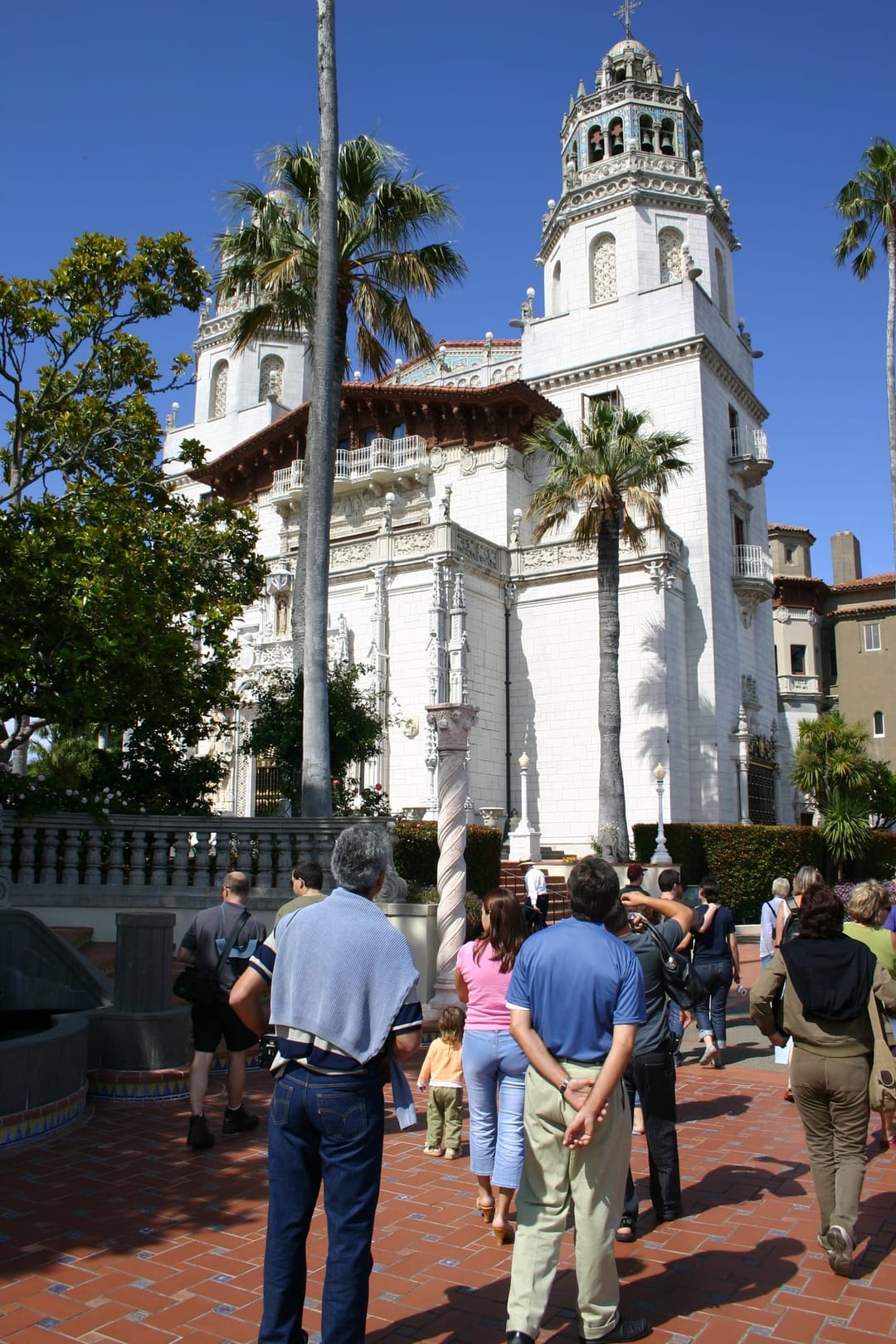
The Classic Hollywood History of Hearst Castle: Celebrity Stories, Scandals, and How to Visit
The celebrity stories, scandals, and shenanigans of Hearst Castle, William Randolph Hearst's San Simeon estate, plus how to visit La Cuesta Encantada today.
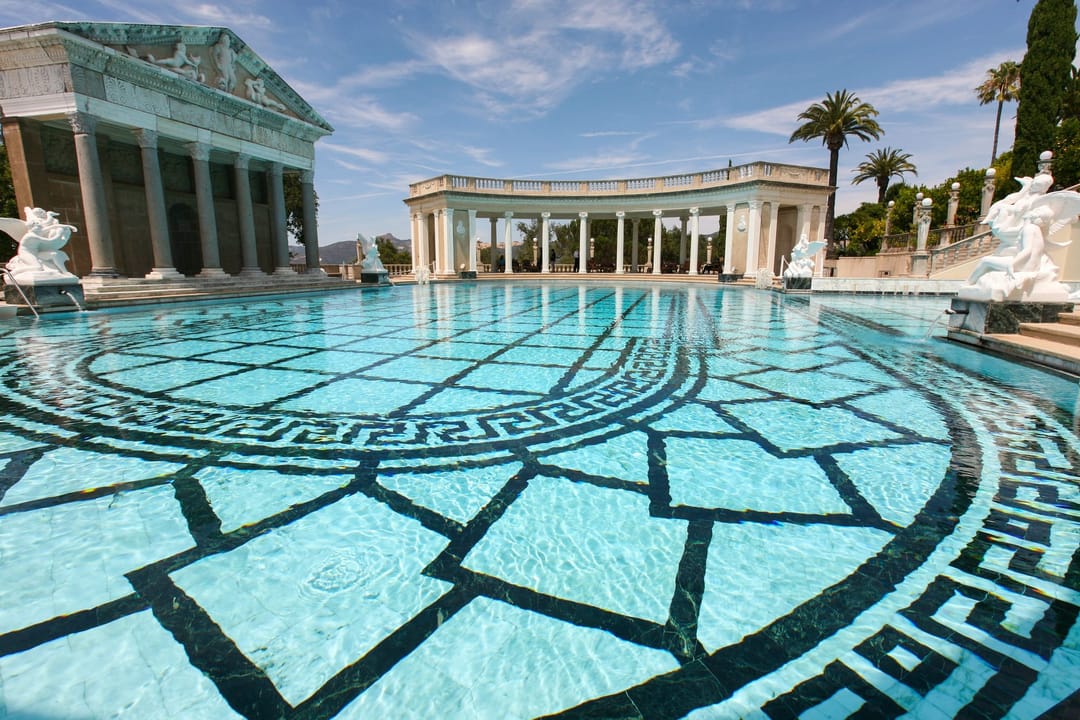
Swimming Pools of Classic Hollywood
From the Neptune Pool at Hearst Castle to the cabanas of the Beverly Hills Hotel, discover the iconic swimming pools where Hollywood's elite lounged, schemed, and made history.
Nearby
Continue the tour